
48% of startups fail within five years — yet the problem isn’t always the product. Confusing a business model with a business plan is a common strategic misstep that can sink even the most promising venture.
Inside the Article:
- What a business model is and how it differs from a business plan
- The nine components of the Business Model Canvas
- Common business model types with real-world examples
- Key components of a business plan
- Which one to build first and why
What is a Business Model?
A business model outlines how a business creates, delivers, and captures value. It’s a conceptual structure that defines the product or service offering, target customers, and how the company intends to generate revenue. Essentially, the business model answers the question: “How do we make money?” It serves as a blueprint for how the business operates and competes in the market, focusing on the core logic of the business idea. It’s a high-level outline, not a detailed roadmap.
The Nine Components of the Business Model Canvas
The Business Model Canvas, developed by Strategyzer Co-founder Alexander Osterwalder, is a strategic management template for developing new or documenting existing business models. It visually represents the nine essential building blocks that show the logic of how a company intends to make money. This canvas is used by millions of entrepreneurs in 180+ countries as the standard one-page business model framework. By focusing on these components, entrepreneurs can clearly define and communicate their business strategy to stakeholders.
- Customer Segments: Define the different groups of people or organizations your business aims to reach and serve.
- Value Propositions: Describe the bundle of products and services that create value and solve customer problems.
- Channels: Outline how you communicate with and deliver value to your customer segments.
- Customer Relationships: Specify the types of relationships you establish with each customer segment (e.g., personal assistance, self-service, automated).
- Revenue Streams: Identify how the business earns income from each customer segment (e.g., sales, subscriptions, licensing).
- Key Resources: List the most important assets required to make the business model work (e.g., physical, intellectual, human, financial).
- Key Activities: Highlight the most important actions the company must take to operate successfully (e.g., production, problem solving, platform/network management).
- Key Partnerships: Note the network of suppliers and partners that help the business operate and reduce risk or acquire resources.
- Cost Structure: Describe the major costs incurred while operating the business model and which resources and activities are most expensive.
Common Business Model Types
Different types of business models exist, each with its own approach to creating and delivering a value to a customer base.
A subscription-as-a-service model, like Netflix, provides ongoing access to a product or service for a recurring fee. Platform business models, such as Airbnb and Uber, connect buyers and sellers, creating a marketplace. Understanding these different types of business models can help entrepreneurs choose the most suitable structure for their business and how they will generate revenue in the future.
- Subscription: Recurring revenue for ongoing access (e.g., Netflix).
- Platform/Marketplace: Connects buyers and sellers, facilitates transactions (e.g., Airbnb, Uber).
- Freemium: Basic service free, premium features paid; common in SaaS and apps.
- Ad-supported: Content or service monetized primarily through advertising (e.g., many media sites, social platforms).
- Razor and Blade: Base product sold low-cost, consumables or accessories sold at higher margins (e.g., printers and ink).
- Licensing: Monetize intellectual property by licensing technology, content, or brand to others.
- Direct Sales: Sell products or services straight to customers via retail, online stores, or sales teams.
- Brokerage/Aggregator: Earn fees or commissions for facilitating transactions or aggregating supply (e.g., brokers, comparison sites).
What is a Business Plan?
Key Components of a Business Plan
A business plan is a detailed document defining a company’s goals, strategies, and how it intends to achieve them. Unlike a business model, which is conceptual, the business plan provides a concrete blueprint for execution. It typically encompasses several key elements, including:
- An executive summary
- Market analysis
- Organizational structure
- Product or service descriptions
- Commercial strategies (sales, marketing, etc.)
- Financial projections
In short, a business plan provides a comprehensive overview of the business.
Importance of a Business Plan
A business plan is essential, whether you’re launching a startup or scaling an established business. According to Harvard Business Review, entrepreneurs who write formal business plans see significant advantages, such as:
- Being 16% more likely to achieve viability.
- Being 260% more likely to actually start their business.
These plans are also crucial for other reasons. For example, they help attract investors and lenders, with 69% of VCs requiring a business plan before investing. Moreover, companies with a business plan experience 30% faster growth.
Business Plan and Business Model: Key Differences
By understanding the business model vs business plan differences, entrepreneurs can effectively navigate the complexities of starting and growing a startup.
| Aspect | Business Model | Business Plan |
|---|---|---|
| Definition | The high-level framework describing how a company creates, delivers, and captures value (who the customers are, what it offers, revenue drivers, cost structure). | A detailed document that defines the company’s strategy, operations, financial projections, and milestones to guide execution and secure funding. |
| Primary Purpose | Explain how the business makes money and sustains itself. | Plan execution, set goals, allocate resources, and communicate strategy to investors, partners, and internal teams. |
| Timeframe | Ongoing and often evolves with market feedback (short–medium term focus on viability). | Typically covers a multi-year horizon (1–5 years) with specific milestones and timelines. |
| Focus | Value creation: customers, channels, pricing, and cost drivers. | Operational and financial details: market analysis, marketing plan, staffing, budgets, and cash flow forecasts. |
| Level of Detail | High-level and conceptual; can be summarized on a single page or a business model canvas. | Comprehensive and granular; includes narrative, charts, and financial statements. |
| Components/Elements | Customer segments, value propositions, channels, customer relationships, revenue streams, key activities, resources, partners, cost structure. | Executive summary, company description, market research, product/service details, marketing & sales strategy, operations, management team, financial projections, funding needs. |
| Audience | Internal teams for strategy and quick alignment; also useful for partners and investors as an overview. | Investors, lenders, internal management, and external stakeholders requiring detailed planning and financial justification. |
| Flexibility | Highly flexible and should be iterated frequently based on testing and customer feedback. | More formal and stable but should be updated periodically as assumptions change. |
| When to Use | When validating your core offer, pricing, and revenue logic; early-stage hypothesis testing. | When seeking funding, planning growth, hiring, or coordinating detailed execution. |
| Typical Output | Business Model Canvas, one-page summaries, positioning statements. | Written plan (PDF/print), slide deck for investors, detailed financial models. |
| Key Metrics | Customer acquisition cost, lifetime value, gross margin, churn, unit economics. | Revenue forecasts, break-even point, cash runway, profitability, ROI. |
| Aspect | Business Model | Business Plan |
|---|---|---|
| Definition | The high-level framework describing how a company creates, delivers, and captures value (who the customers are, what it offers, revenue drivers, cost structure). | A detailed document that defines the company’s strategy, operations, financial projections, and milestones to guide execution and secure funding. |
| Primary Purpose | Explain how the business makes money and sustains itself. | Plan execution, set goals, allocate resources, and communicate strategy to investors, partners, and internal teams. |
| Timeframe | Ongoing and often evolves with market feedback (short–medium term focus on viability). | Typically covers a multi-year horizon (1–5 years) with specific milestones and timelines. |
| Focus | Value creation: customers, channels, pricing, and cost drivers. | Operational and financial details: market analysis, marketing plan, staffing, budgets, and cash flow forecasts. |
Which Comes First?
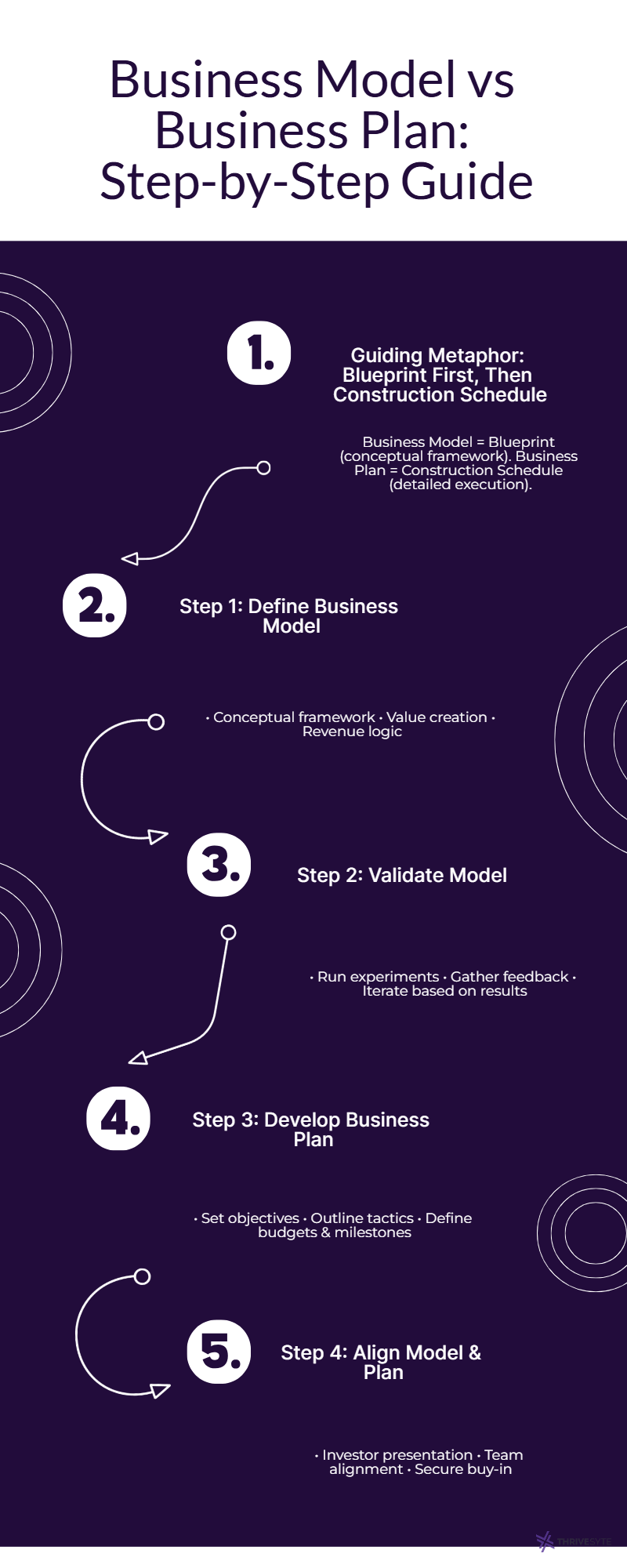
Begin with the business model because it defines the underlying logic of your venture: how you create value for customers, how you deliver it efficiently, and how you capture revenue. Establishing this conceptual framework first matters because it filters strategic choices—target market, pricing, channels—so you avoid committing resources to unworkable approaches.
Once the model is clear, treat it as a guide that exposes dependencies and risks; this clarity lets you prioritize experiments and resource allocation. Translating the model into a concrete business plan is the next critical step because the plan converts hypotheses into executable steps: objectives, tactics, budgets, milestones, and shows how day‑to‑day operations will realize the model’s promise.
Finally, align and communicate both model and plan to investors, partners, and team members to assess viability and provide informed support. Think of the model as an architect’s blueprint and the plan as the construction schedule: the blueprint explains why the structure stands, the schedule ensures it gets built on time and on budget, and presenting both together secures the commitment needed to succeed.
Can a Business Model Replace a Business Plan?
While a business model is essential, it cannot entirely replace a business plan. A business model provides the high-level outline of how the business makes money. However, a business plan is a detailed document that specifies the specific steps required to achieve the entrepreneur’s goals. A business plan provides critical information, such as financial forecasts and go-to-market strategies, which are necessary for securing funding and steering business growth. 42% of startups fail because they built a product or service nobody wanted.
Real-World Examples
Netflix: Evolution of a Business Model
Netflix began as a DVD-by-mail service in 1997, demonstrating an initial business model focused on convenience and accessibility. As technology evolved, Netflix pivoted to streaming in 2007, adapting to changing consumer preferences. In 2013, it transformed again by investing in original content, solidifying its position as a dominant force in entertainment. Each pivot was a business model redesign, not simply a product update, driven by shifting customer behaviour and technology.
Airbnb and Uber followed a similar logic, using platform models to scale without the traditional cost burdens of asset ownership.
Core Engagement Layer
Workforce AI Enablement
Workforce readiness and AI adoption training is built into every consulting engagement from day one. Organisations seeking standalone AI training programmes — for teams, managers, or executives — can explore our Academy offerings.
Airbnb: Platform/Marketplace Model
Airbnb, founded in 2008, exemplifies a platform/marketplace model. Connecting travelers with homeowners, Airbnb has disrupted the hospitality industry. By 2023, Airbnb had over 7 million listings in 220+ countries, showcasing its global reach and scalability. Significantly, Airbnb does not own a single property, highlighting the efficiency of its asset-light business model.
Uber: Disruption of the Ride-Sharing Industry
Uber’s platform, launched in 2009, revolutionized the transportation sector. By connecting riders and drivers through a mobile app, Uber disrupted the $108 billion global taxi industry. Like Airbnb, Uber operates without owning any vehicles, leveraging a network of independent contractors.
Why You Need Both
To thrive, entrepreneurs need both a robust business model and a comprehensive business plan. The business model helps conceptualize how your business will create, deliver, and capture value for the customer. A business plan then translates this concept into a detailed roadmap for execution. Together, with the business model, it creates a cohesive business strategy for success.
Failing to develop a business plan could be detrimental to your business. Remember, 69% of VCs never invest without first reviewing a business plan, according to Upmetrics. Potential investors and stakeholders often require a well-articulated plan to assess the viability and scalability of your business idea as well as to provide a clear and compelling case for investment. It demonstrates that you have thoroughly researched the market, identified your target customers, and developed a viable go-to-market strategy.
Common Mistakes To Avoid
One common mistake is confusing the business model with the business plan. Thinking of the business model as a roadmap and the business plan as a detailed set of instructions is not the correct way to look at it. The business model is a conceptual framework, while the business plan is a detailed document detailing how the business will achieve its goals. Confusing these two can lead to a misaligned business strategy. Another is not considering enough different types of business models.
Another pitfall is creating a business plan without first validating the business model. It’s crucial to ensure that your value proposition resonates with your target market and that your sources of revenue are sustainable. Failing to validate your business model can result in a business plan that is based on flawed assumptions.
Conclusion
In conclusion, understanding the difference between a business model and business plan is critical for entrepreneurs seeking sustainable success. A business model provides the conceptual framework for how your business will operate and grow, while the business plan defines the specific steps to achieve your goals. By developing a strong business model and translating it into a comprehensive business plan, you increase your chances of attracting investment and navigating the complexities of the competitive landscape. Don’t fall victim to the common mistakes that lead to failure; instead, leverage both tools to build a solid foundation for your business. If you’re ready to take your business idea to the next level, work with Thrivesyte to build both a winning business model and a fundable business plan.
Decision Maker Resource
Where does your organisation sit on the AI readiness curve?
Find out in 5 minutes. No consultant required.
Our AI Readiness Scorecard gives you a structured maturity score across five dimensions — data, process, infrastructure, workforce, and use-case clarity. Designed for decision-makers, not IT teams.
Interactive AI Readiness Diagnostic
Complete this 5-step self-assessment to map your organizational infrastructure against five critical pillars of professional AI adoption: data readiness, process standardization, software stack integration, team capabilities, and strategic use-case clarity.
FAQ
1. What’s the difference between a business plan and a business model?
A business model describes the essence of your business i.e. how your business will generate value and revenue, who the core customers are. A business plan is a document describing the detailed framework for executing that model; the plan includes financial projections, marketing and sales plan, business operations, and responsibilities of business partners. In short, a business model explains the what and why, while a business plan details the how.
2. When starting a business, should I use a business model or a business plan first?
Start by defining your business model so you understand customer needs, core business activities, and how the business will generate income. Once the model is clear, writing a business plan translates that model into a plan is a more detailed, actionable document for internal and external stakeholders, fundraising, and business development.
3. Can a business have multiple business models, and how does that affect the business plan?
Yes, some companies operate with multiple models such as combining subscription and freemium offerings. Each model changes how your business will generate revenue and may require separate sections in your business plan to address operations, financial forecasts, and how you will grow your business across different segments.
4. Who uses a business plan vs a business model, and who benefits from updating them?
A business owner and business development teams use both: the business model allows quick iteration and communication with internal teams, while the business plan is a document used by stakeholders like investors and business partners. As your business grows or market conditions shift, update your plan and revisit your model so your business goals, operations, and financials remain aligned.
5. Are there popular business models I should consider when writing my plan?
Popular models include subscription, marketplace, freemium, and direct sales. Choose models that match customer needs and your core business strengths.